 Lost Chapters
The Real Story of Wardenclyffe Tower, Tesla's Lost Dream
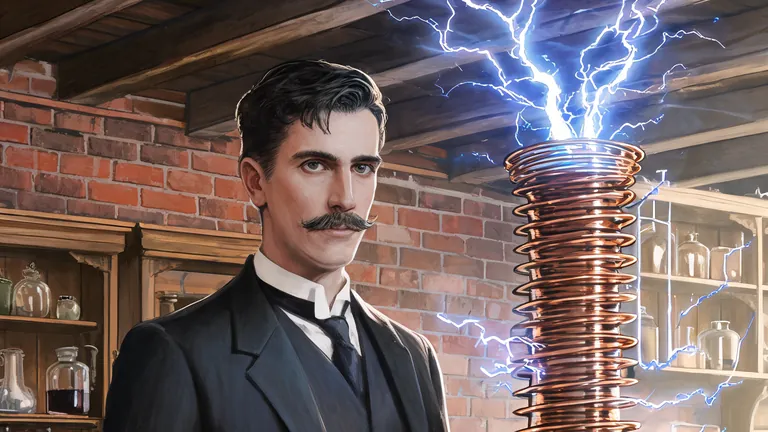
Short answer: Wardenclyffe Tower was a 187-foot wireless transmitter that Nikola Tesla began building in 1901 at Shoreham, on Long Island, New York, with $150,000 from J. P. Morgan. Tesla hoped it would send messages, and eventually power, without wires. The money ran out, the tower never became operational, and it was torn down in 1917 to help pay Tesla's debts. His brick laboratory still stands and is being turned into a science center.
Wardenclyffe tower history is a story about a brilliant idea, a famous investor and a race Tesla did not know he was losing. It is also the inspiration for Tesla's Command in Lost Chapters. Here is what really happened, and how the game borrows it.
Real history: the inventor before the tower
Nikola Tesla was born in 1856 in Smiljan, a village in today's Croatia, then part of the Austrian Empire. He arrived in New York in 1884. (A Library of Congress research guide gives 1883; most sources, including the Tesla Science Center, say 1884.)
His big breakthrough was a system of alternating current (AC) motors and power transmission. His patents were granted in 1888, and George Westinghouse bought the rights that year. AC went on to light the 1893 World's Columbian Exposition in Chicago, and in November 1896 power from the Adams plant at Niagara Falls reached Buffalo on a Westinghouse AC system. AC is still how most of the world moves electricity.
By the late 1890s, Tesla was chasing something bigger: wireless transmission. In 1899 he built an experimental station in Colorado Springs, funded with $30,000 from John Jacob Astor. PBS describes artificial lightning bolts more than a hundred feet long leaping from its mast, and one test that burned out the local power company's dynamo and blacked out the town. Tesla came back to New York ready to build something much bigger.
Real history: building Wardenclyffe (1901 to 1906)
In 1901, J. P. Morgan agreed to put $150,000 into Tesla's plan. Construction began that year on a site in Shoreham, Long Island. The famous architect Stanford White designed the brick laboratory and the tower (the National Park Service credits his firm, McKim, Mead and White).
What Tesla built was striking even by today's standards:
| Fact | Detail |
|---|---|
| Location | Shoreham, Long Island, New York |
| Construction began | 1901 |
| Main funder | J. P. Morgan, $150,000 |
| Tower height | 187 feet |
| Top | A metal dome about 68 feet across |
| Purpose | A transmitter for wireless communication and power |
| Status | Never became operational |
| Demolished | 1917 |
The National Park Service describes Tesla's goal as a "World Wireless System" to send energy and telecommunications without wires.
Real history: why it failed
Three problems hit Wardenclyffe at once.
Marconi got there first. On December 12, 1901, Guglielmo Marconi signaled the letter "S" across the Atlantic by radio, using far simpler equipment. Tesla's grand system suddenly had a working competitor.
The money ran out. According to the Tesla Science Center, Morgan grew skeptical of the commercial case for wireless power and stopped funding. Work stalled. Sources give slightly different dates, but the project had effectively ended by 1906.
Debt caught up. In 1915, short of money, Tesla lost control of the property. According to the Tesla Memorial Society of New York, he had run up large bills at the Waldorf-Astoria hotel, and the deed to Wardenclyffe went toward that debt.
In 1917 the tower was dismantled. The Tesla Science Center says the courts ordered it demolished and sold as scrap to repay the debt. You may have read that the government blew it up because it feared German spies during World War I. That story is popular, but we could not find documents that support it. The debt explanation is the one the record backs.
In a 1905 article, Tesla defended the idea in a line PBS quotes: "It is not a dream. It is a simple feat of scientific electrical engineering, only expensive." He was right about the expensive part.
Real history: what happened to the site
The tower is gone, but the large octagonal base and Stanford White's brick laboratory survived. For decades the property was used by private companies; the Tesla Science Center says the last business on the site stopped operating in 1987.
Then the internet stepped in. In August 2012, cartoonist Matthew Inman of The Oatmeal launched a crowdfunding campaign to save the lab. It raised about $1.37 million from more than 33,000 donors. With that money and a matching grant from New York State, the Tesla Science Center at Wardenclyffe bought the property in May 2013.
Wardenclyffe was added to the National Register of Historic Places in 2018. It is the only one of Tesla's laboratories still standing. A fire in November 2023 damaged the roof and part of the lab, but engineers reported that the building's structure survived. Restoration work is ongoing, so check the Tesla Science Center's website before planning a visit.
Wardenclyffe Tower history: myths and facts
- Myth: Wardenclyffe sent free power through the air. Fact: The tower never became operational.
- Myth: The government destroyed it to stop spies. Fact: The documented reason is debt; the tower was sold for scrap.
- Myth: The tower still stands on Long Island. Fact: Only the tower's base and Stanford White's laboratory survive. Tesla himself died in New York on January 7, 1943.
In the game: Tesla's Command
This section is about Lost Chapters, not history.
In Lost Chapters, Nikola Tesla leads Gold, the colour of inventors and industry. His Leader passive gives your Inventors +1/+0, and once per turn he can pay 2 crystals to Build a Tinker Token. His once-per-match Command is called Wardenclyffe Tower: for 4 crystals, Build 2 Tinker Tokens, and your Inventors get +1/+0 this turn. It is the moment a Tesla deck goes from a few gadgets to a whole workshop charging at once.
In the game's invented story, Tesla is the first hero to fall into Marginalia, and he never stops sketching his tower on napkins. That is our fiction. The real tower is the one above: unfinished, expensive and still inspiring people more than a century later.
Gold has plenty of real history to explore. Thomas Edison and George Westinghouse are both in the set, and Benjamin Franklin's famous experiment shows up as Kite and Key. For a Tesla deck, The Workshop builds a Tinker at the end of every turn, and Genius Convention can swing a game when it turns up as a lost Life card.
Build your own tower
Want to see Wardenclyffe go up? Tesla is the Leader you learn with in the First Chapter, so you can play him within minutes. Play Lost Chapters free in your browser, pick Tesla's Workshop as your first deck, and save that Command for the turn your Inventors are ready to charge.
Sources
- Tesla's Wireless Power, Tesla Science Center at Wardenclyffe
- Tower Dismantled, Tesla Science Center at Wardenclyffe
- Our Journey, Tesla Science Center at Wardenclyffe
- Wardenclyffe Added to the National Register of Historic Places, Tesla Science Center
- Wardenclyffe Laboratory, National Park Service
- Tesla: Life and Legacy, Tower of Dreams, PBS
- Tesla: Life and Legacy, Colorado Springs, PBS
- Tesla: Life and Legacy, War of the Currents, PBS
- Nikola Tesla, Lemelson Center / MIT
- Wardenclyffe, Tesla Memorial Society of New York
- Chronicling America: Nikola Tesla, Library of Congress
Cards in this post
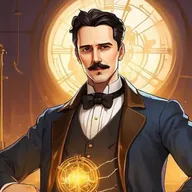 Nikola Tesla, Father of Electricity8 crystals · Character · Legendary
 Thomas Edison, Static Hero7 crystals · Character · Ultra-Rare
 George Westinghouse5 crystals · Character · Uncommon
 Kite and Key2 crystals · Item · Common
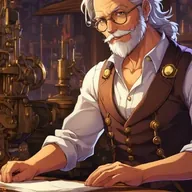 The Workshop3 crystals · Location · Uncommon
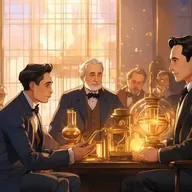 Genius Convention7 crystals · Event · Rare
Leaders: Nikola Tesla