 Lost Chapters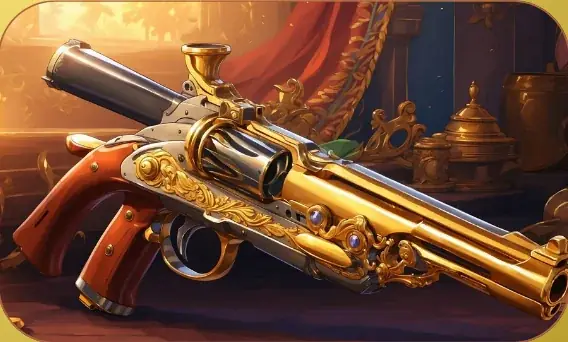
Flintlock: Gold Item
A flintlock musket fired when a piece of flint held in the gun's hammer struck a steel plate called the frizzen. The sparks lit a small pile of gunpowder in the pan, and the flame passed through a tiny hole in the barrel, the touchhole, to ignite the main powder charge that pushed the lead ball out.
- Cost
- 4 crystals
- Type
- Item · Weapon
- Color
- Gold (Inventors & Industry)
- Rarity
- Common
- Set
- Liberty & Lightning (Set 1)
Equip: +3/+0.
Revolutionary firearm that made combat more efficient while creating dramatic smoke effects for battlefield aesthetics.
The real history
The flintlock was the main way to fire a gun through the 1700s and into the early 1800s. Its parts were simple. A piece of flint was gripped in the jaws of the hammer, which is also called the cock. A steel plate called the frizzen stood in front of it, and below that was the pan, a small trough for loose gunpowder.
When the soldier pulled the trigger, the hammer swung forward and the flint scraped down the frizzen. That threw off red-hot sparks that dropped into the pan. The powder in the pan flared, and the flame went through the touchhole into the barrel to set off the main charge.
Loading took many steps, and each one mattered. A musket was loaded from the front: powder and a lead ball went down the barrel, and loose powder went in the pan. American troops in 1846 were taught a drill of twelve separate motions to load and fire.
Flintlocks often failed. The loose powder varied from shot to shot, and damp weather could ruin it. Sometimes the pan flared but the main charge did not fire, which gave us the saying "a flash in the pan."
The British Brown Bess was the standard infantry musket for more than a century, including in the American Revolution. It shot a lead ball about three-quarters of an inch wide, and even trained soldiers fired only two or three shots a minute. It was a smoothbore with no rifling, and experienced soldiers put its useful range at 50 to 100 yards, which is why armies fought in tight lines. The flintlock was later replaced by the percussion lock.
Sources
- Soldiers stare down the barrel of the Brown Bess, National Park Service
- A Glossary of Small Arms Across Three Wars, American Battlefield Trust
- Lock, Stock, & Barrel, National Park Service
- Design Your Flintlock, National Park Service
How the card plays
Flintlock costs 4 crystals and is a Gold Item (Weapon). Its card text is Equip: +3/+0, so the character carrying it gets +3 power and no extra health.
Four crystals is a lot for power alone, so put it on a character that can attack safely and stay alive, such as one with Explore or one the rival cannot easily remove. Eli Whitney Eli Whitney searches your deck for an Item, which helps you find it. Finished Product Finished Product gives its equipped character +1/+0 each time you play another Item, so playing the Flintlock after it adds to the same attacker. Cornelius Vanderbilt Cornelius Vanderbilt gives your other characters +1/+1 when he charges, which makes a Flintlock attack on the same turn even harder to stop.
- Playable in decks led by Nikola Tesla, and by any Traveler Leader whose colors include Gold.
- In the Tesla starter deck (1 copy). Deck code:
LC2-BV8BYAFhAWICYwFkAWUCZgFnAWgBaQFqAWsCbAFtAm4BbwFwAXEBcgFzAnQBdQF2AXcBeAJ5AnoBewF8AX0BfgF_AXiK - A deck holds up to 3 copies of this card.
Questions about Flintlock
What does "flash in the pan" mean?
In a flintlock, the loose powder in the pan sometimes lit but failed to fire the main charge in the barrel. All that showed was a quick flash, so the phrase came to mean a burst of effort that leads to nothing.
Related cards





Free in your browser. No download.
Play Flintlock free