 Lost Chapters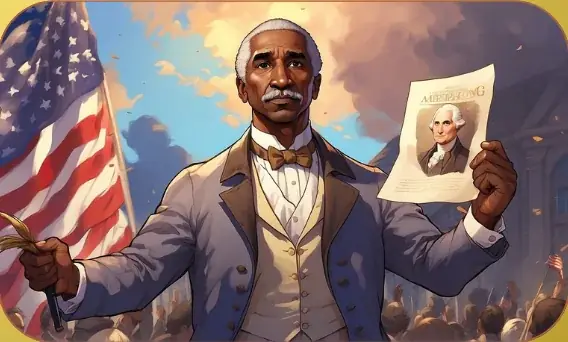
George Washington Carver: Gold Character
George Washington Carver (about 1864 to 1943) was an agricultural scientist and teacher who was born into slavery in Missouri. At the Tuskegee Institute in Alabama he taught Southern farmers to rotate crops and to grow peanuts and sweet potatoes to restore soil worn out by cotton.
- Cost
- 4 crystals
- Type
- Character · Inventor
- Power / Health
- 3 / 5
- Color
- Gold (Inventors & Industry)
- Rarity
- Common
- Set
- Liberty & Lightning (Set 1)
- Keywords
- Protest
On play: draw a card.
Agricultural alchemist who transformed humble peanuts into scientific gold.
The real history
Carver was born enslaved on Moses Carver's farm in Missouri, near the end of the Civil War. The exact date is unknown, and estimates run from 1860 to 1865. He was orphaned as an infant and raised by Moses Carver and his wife after slavery ended. As a boy he was so good with plants that people called him the "plant doctor."
Carver went to school in Neosho, Missouri, and later moved to Iowa. After studying art and music at Simpson College, he transferred to Iowa State Agricultural College, now Iowa State University. He earned a bachelor's degree in 1894 and a master's degree in 1896.
In 1896 Booker T. Washington recruited him to lead agriculture at the Tuskegee Normal and Industrial Institute, where he worked for the rest of his life. He saw that years of cotton had drained Southern soil. He urged farmers to rotate their crops and to plant peanuts and sweet potatoes, and he wrote free bulletins and ran traveling programs to reach them. From peanuts alone he developed hundreds of new products. In 1921 he spoke to a committee of the U.S. House of Representatives on behalf of the peanut industry.
Carver did not invent peanut butter. He filed only three patents, for a cosmetic cream and for paints and stains, and none was for peanut butter. He received the Spingarn Medal in 1923 and died in 1943.
Sources
- George Washington Carver, Science History Institute
- George Washington Carver Patent for Cosmetics, National Archives
- History and Culture, George Washington Carver National Monument, National Park Service
In the game's story
In the game's invented story, Carver arrives in a field outside Dogear Crossing, kneels and finds the soil tired from generations of the same grain. He spends a month walking the farms, then gives a talk in the market square that sends the farmers home arguing about crop rotation, and the next harvest is the best in living memory. He finds dozens of uses for the Inkwash reed, and the Bulwark knights adopt his card as their emblem: the one who holds.
How the card plays
Carver costs 4 crystals and is a 3/5 Common Inventor with Protest, which means your rival can't choose him as the target of a charge. He can still block. When he arrives, draw a card.
That makes him a safe body that replaces himself. With 5 health and no way for the rival to charge him directly, he is a sturdy blocker that holds the line while you build toward bigger plays.
He fits any Gold Inventors deck. Nikola Tesla, Father of Electricity cuts his cost to 3 while it is on the field, and Genius Convention gives all your Inventors +1/+1. Under the Tesla Leader he gets +1/+0 as an Inventor, so he blocks as a 4/5.
- Playable in decks led by Nikola Tesla, and by any Traveler Leader whose colors include Gold.
- In the Tesla starter deck (1 copy). Deck code:
LC2-BV8BYAFhAWICYwFkAWUCZgFnAWgBaQFqAWsCbAFtAm4BbwFwAXEBcgFzAnQBdQF2AXcBeAJ5AnoBewF8AX0BfgF_AXiK - Works with Alexander Hamilton, Young Hopeful; Betsy Ross, Fabric of America.
- A deck holds up to 3 copies of this card.
Questions about Carver
Did George Washington Carver invent peanut butter?
No. The National Archives notes that Carver filed three patents and none was for peanut butter. His real work was finding hundreds of uses for peanuts and teaching farmers to grow them.
Where did George Washington Carver go to college?
He studied at Simpson College in Iowa, then at Iowa State Agricultural College, now Iowa State University, where he earned a bachelor's degree in 1894 and a master's in 1896.
Related cards
 Alexander Hamilton, Young Hopeful2 crystals · Character · Rare
 Betsy Ross, Fabric of America5 crystals · Character · Ultra-Rare
 Nikola Tesla, Father of Electricity8 crystals · Character · Legendary
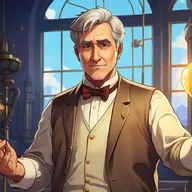 Thomas Edison, Static Hero7 crystals · Character · Ultra-Rare
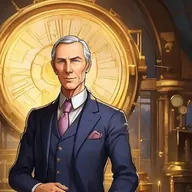 Alexander Graham Bell3 crystals · Character · Rare
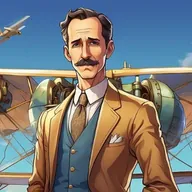 Orville Wright, Brother7 crystals · Character · Rare
Free in your browser. No download.
Play Carver free