 Lost Chapters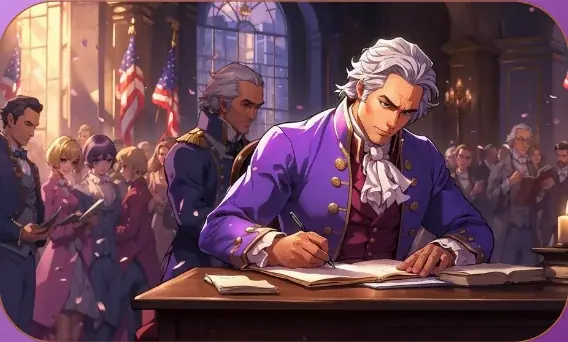
Sign Your Name: Quartz Event
Fifty-six delegates to the Continental Congress signed the Declaration of Independence, starting with John Hancock, the president of Congress. Congress voted for independence on July 2 and approved the Declaration on July 4, 1776, but most delegates signed the parchment copy on August 2, and a few signed later.
- Cost
- 2 crystals
- Type
- Event · Triumph
- Color
- Quartz (Founders & Revolution)
- Rarity
- Common
- Set
- Liberty & Lightning (Set 1)
Triumph
Draw 2.
Act that transformed a treasonous document into a national treasure through strategic penmanship.
The real history
The Declaration of Independence is dated July 4, 1776, which is why many people picture every delegate signing that day. The real story took longer. On July 2 the Continental Congress voted for independence, with 12 of the 13 colonies in favor and New York not voting. On July 4 it approved the final wording of the Declaration. Copies printed on July 5 carried only the names of John Hancock and Charles Thomson.
The large parchment copy that visitors see today was written out later. On August 2, 1776, the journal of Congress records that the engrossed Declaration was signed. John Hancock signed first, with a large, bold signature in the center of the page.
Fifty-six delegates eventually signed, representing all thirteen states, though not everyone was in Philadelphia on August 2. Five signed after that date: Elbridge Gerry, Oliver Wolcott, Lewis Morris, Thomas McKean and Matthew Thornton. Famous signers include Thomas Jefferson, the main author, as well as John Adams, Benjamin Franklin, Samuel Adams and Roger Sherman.
Not every delegate who helped with the Declaration signed it. Robert R. Livingston of New York was on the five-member committee that drafted it, but he never signed.
Sources
- Declaration of Independence (1776), National Archives
- Declaration of Independence: History, National Archives
- Declaration of Independence: A Transcription, National Archives
How the card plays
Sign Your Name costs 2 crystals and is a Quartz Event. It has Triumph, a game term meaning that if it is revealed from your Life cards you may play it for free. When it resolves, you draw 2 cards.
For 2 crystals it is one of the cheapest ways to refill your hand, so it fits almost any Quartz deck and is easy to slot in on a turn when you have a spare crystal or two. Its real strength is speed: it replaces itself and gives you an extra card. The Founders that sign it with you are the stars. John Hancock draws a card when you control another Founder, Benjamin Franklin builds a Lightbulb Token and draws, and National Convention makes your Founders cost 1 less and gives them +1/+1.
- Playable in decks led by George Washington, and by any Traveler Leader whose colors include Quartz.
- In the Washington starter deck (1 copy). Deck code:
LC2-BhoCgAKBAYIBgwGEAYUBhgKHAYgBiQGKAYsBjAKNAY4BjwGQAZEBkgGTAZQBlQGWAZcBmAGZAZoCmwGcAZ0BngGfAaABoQFBjA - A deck holds up to 3 copies of this card.
Questions about Sign Your Name
Did everyone sign the Declaration of Independence on July 4?
No. Congress approved the text on July 4, 1776, but the parchment copy was signed mostly on August 2, and several delegates signed even later.
Who signed the Declaration of Independence first?
John Hancock, the president of the Continental Congress, signed first, with a large signature in the center of the page.
Related cards



Free in your browser. No download.
Play Sign Your Name free