 Lost Chapters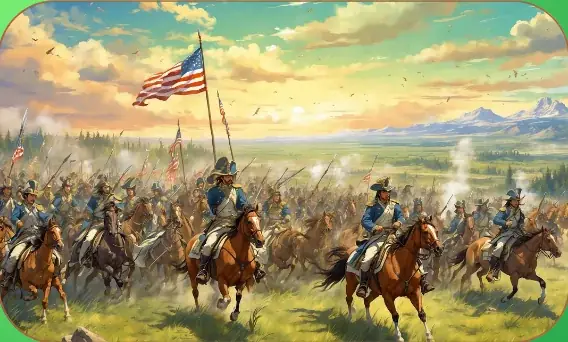
Battle of Little Bighorn: Emerald Event
The Battle of the Little Bighorn was fought on June 25 and 26, 1876, in south-central Montana, where Lakota, Northern Cheyenne and Arapaho warriors defeated the U.S. 7th Cavalry led by Lt. Col. George Armstrong Custer. Custer's immediate command of about 210 men was wiped out, though the Army ultimately pressed on and most Native groups surrendered within a year.
- Cost
- 7 crystals
- Type
- Event · Battle
- Color
- Emerald (Frontier & Explorers)
- Rarity
- Rare
- Set
- Liberty & Lightning (Set 1)
Deal 3 damage to each enemy character.
Military disaster where tactical hubris transformed a routine campaign into Custer's last and most memorable mistake.
The real history
The battle grew out of a broken promise. The 1868 Treaty of Fort Laramie set aside a large reservation for the Lakota in western South Dakota, including the Black Hills. In 1874 Custer led an expedition into the Black Hills that found gold, and miners poured in illegally. The Lakota refused to sell the land. In late 1875 the government ordered all Lakota to report to reservations by January 31, 1876, or face military action.
In June 1876 a huge village of about 8,000 people, with an estimated 1,500 to 1,800 warriors, camped along the Little Bighorn River. Leaders there included Sitting Bull and Crazy Horse. Custer led 12 companies of the 7th Cavalry, with Crow and Arikara scouts, toward the village.
On June 25 the fighting began. Major Marcus Reno's and Captain Frederick Benteen's soldiers took a defensive position and were besieged through the night and into the next day, while Custer's command was destroyed. About 268 soldiers, civilians and scouts were killed on the Army's side, along with an estimated 60 to 100 Lakota and Cheyenne.
On June 26 the village moved up the valley after scouts reported another column of soldiers, under General Alfred Terry, coming. Terry and Colonel John Gibbon arrived on June 27 and found Custer's dead.
The Lakota and Cheyenne won the battle, but it hardened U.S. resolve. The government increased its efforts against Native peoples, most groups surrendered within a year, and the Black Hills were taken without payment.
Sources
- Story of the Battle, Little Bighorn Battlefield National Monument, National Park Service
- A Chronology of the Battle of the Little Bighorn, Little Bighorn Battlefield National Monument, National Park Service
How the card plays
Battle of Little Bighorn costs 7 crystals and is an Emerald Event with the Battle type and Rare rarity. It deals 3 damage to each enemy character.
It is a big board wipe for any enemy with 3 health or less per character. Count your opponent's field before you play it, and wait until they have committed several characters, since it hits every one of them. Damage wears off at the end of the turn, so attack right after to finish the survivors. Battle of Bunker Hill deals 4 damage to one enemy character and then 2 to each, so the two cards handle even large enemies. Buffalo Bill deals 2 damage to a single enemy when played, and Alvin York deals 1 damage when it charges, both good at finishing a character that survived with a point or two of health.
- Playable in decks led by Amelia Earhart, and by any Traveler Leader whose colors include Emerald.
- In the Earhart starter deck (1 copy). Deck code:
LC2-Ax8CIAEhASIBIwIkAiUBJgEnASgCKQEqAisBLAEtAS4BLwEwATEBMgEzATQBNQE2ATcBOAE5AToBOwE8AT0BZQJ0Anuc - A deck holds up to 3 copies of this card.
Questions about Battle of Little Bighorn
Who won the Battle of the Little Bighorn?
The Lakota, Northern Cheyenne and Arapaho warriors won. Custer's immediate command of about 210 men was annihilated, but the U.S. government stepped up its campaign afterward and most groups surrendered within a year.
Related cards


Free in your browser. No download.
Play Battle of Little Bighorn free