 Lost Chapters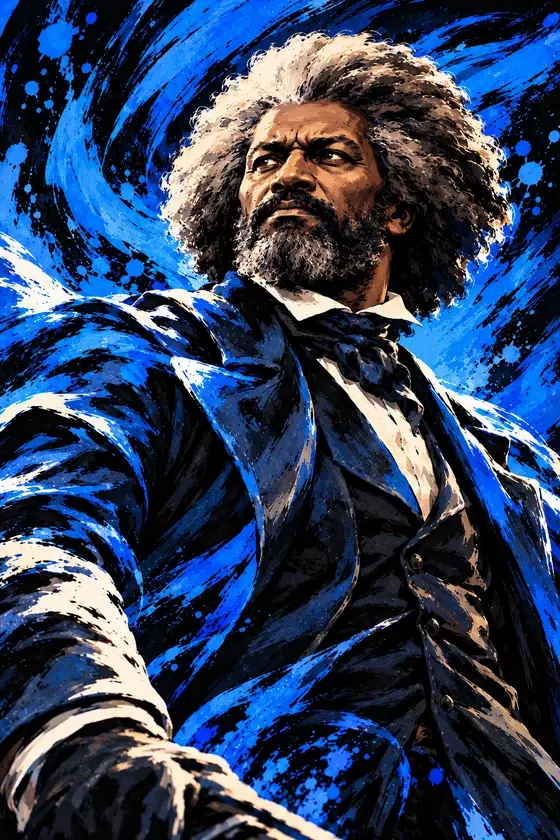
Frederick Douglass: Cobalt Character
Frederick Douglass (1818 to 1895) escaped slavery in Maryland in 1838 and became the most important leader of the movement for African American civil rights in the 19th century. He was a famous abolitionist speaker and writer, published his own newspaper, met with President Lincoln during the Civil War and later held several federal offices.
- Cost
- 5 crystals
- Type
- Character · Thinker
- Power / Health
- 4 / 4
- Color
- Cobalt (Thinkers & Dreamers)
- Rarity
- Rare
- Set
- Liberty & Lightning (Set 1)
On play: your Thinkers get +1/+1.
When destroyed: Recover 1.
Self-liberated orator whose powerful autobiography and thunderous speeches made slavery's horrors undeniable.
The real history
Frederick Augustus Washington Bailey was born into slavery in Talbot County, Maryland, in February 1818. He was never allowed to attend school, so he taught himself to read and write on the streets of Baltimore. At 12 he bought The Columbian Orator, a collection of famous speeches.
A free Black woman named Anna Murray helped him plan his escape. On September 3, 1838, dressed as a sailor and using her money for the ticket, he boarded a northbound train and reached New York City in less than 24 hours. The couple married and took the last name Douglass.
Douglass became a powerful antislavery lecturer, but some audiences doubted he had ever been enslaved. In 1845 he answered them with Narrative of the Life of Frederick Douglass, an American Slave, which named real people and places and became a bestseller. To avoid being recaptured, he spent almost two years speaking in England, Ireland and Scotland, and supporters there purchased his freedom.
Back home, he settled in Rochester, New York, and in 1847 began publishing his own newspaper, The North Star. He was the only African American at the 1848 women's rights convention in Seneca Falls.
During the Civil War he recruited Black soldiers, including two of his own sons, and met with Lincoln to press for equal pay and treatment for Black troops. After the war he served as U.S. Marshal for the District of Columbia, Recorder of Deeds and minister to Haiti. He died at his Washington home, Cedar Hill, on February 20, 1895.
Sources
- Frederick Douglass, National Park Service
- Frederick Douglass, Frederick Douglass National Historic Site, National Park Service
- Frederick Douglass Timeline, Digital History, University of Houston
In the game's story
In the game's invented story, Douglass is shown his page at the Archive of Lost Histories, a correct but lifeless list of dates and facts, and he hands it back and asks for a pen. He spends three days rewriting it in his own words, the first arrival ever to rewrite his own page. Now he passes his days in the Archive's lower stacks reading lost chapters aloud, and he speaks to full crowds at Barnum's tent.
How the card plays
Frederick Douglass costs 5 crystals and is a 4/4 Rare Cobalt Thinker. When he enters play, your Thinkers get +1/+1, and the boost stays for the rest of the game. When he is destroyed, Recover 1, so the top card of your deck goes into your Life, up to 5.
He is a Signature card of the Dr. King Leader, so he costs 4 in that deck. Play him after two or three Thinkers are already on the field to get the most from the boost. Even if he is removed, he leaves a Life card behind.
Emily Dickinson Emily Dickinson and Nathaniel Hawthorne Nathaniel Hawthorne are cheap Thinkers to play first. Writers Convention Writers Convention gives Thinkers another +2/+2 and draws you a card at the end of your turn while you control one.
- Playable in decks led by Martin Luther King Jr., Neil Armstrong.
- A Signature card of Martin Luther King Jr.: it costs 1 less while Dr. King leads your deck.
- In the Dr. King starter deck (2 copies). Deck code:
LC2-BAABAQICAQMBBAEFAQYBBwEIAQkCCgILAQwBDQIOAg8BEAIRARICEwIUAhUBFgEXARgBGQEaARsBHAEdAR4B3v4 - In the Armstrong starter deck (1 copy). Deck code:
LC2-AQABAQECAQMBBAEFAQYBBwEIAgkCCgILAQwBDQIOAQ8BEAERARICEwIUARUBFgEXARgBGQEaARsBHAIdAR4BfQK1eQ - A deck holds up to 3 copies of this card.
Questions about Douglass
What did Frederick Douglass write?
He wrote three autobiographies: Narrative of the Life of Frederick Douglass, an American Slave (1845), My Bondage and My Freedom (1855) and Life and Times of Frederick Douglass (1881). He also edited his own newspaper, The North Star, and wrote many speeches and articles.
Did Frederick Douglass meet Abraham Lincoln?
Yes. During the Civil War he met with Lincoln to protest the unequal pay and treatment of Black soldiers. He also attended Lincoln's second inauguration.
Card art
The standard version of Frederick Douglass. The Full Art above is a rare version that can appear in packs.

Related cards
 Robert Frost5 crystals · Character · Rare
 Emily Dickinson2 crystals · Character · Uncommon
 Nathaniel Hawthorne4 crystals · Character · Uncommon
 Hamilton, Immigrant Scholar2 crystals · Character · Uncommon
 William Faulkner2 crystals · Character · Common
 Martin Luther King Jr.7 crystals · Character · Legendary
Free in your browser. No download.
Play Douglass free