 Lost Chapters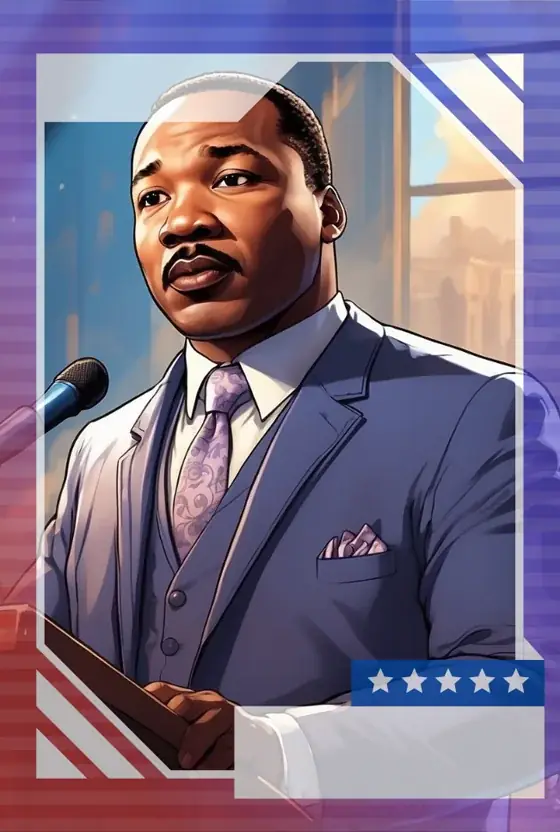
Martin Luther King Jr.: Cobalt Leader
Resolve and unity. Characters that survive pressure grow stronger together.
- Color
- Cobalt (Thinkers & Dreamers)
- Leader power
- 5
- Passive
Your characters have Resolve.
End of your turn: if you control 4+ characters, draw a card.
- Command
- The March (3 crystals): Your characters get +1/+1. If you control 4+ characters, recover 1 Life.
- Signature cards
- I Have a Dream; Rosa Parks; Frederick Douglass
Game plan
Dr. King leads the Cobalt deck. His passive gives every character you control Resolve: when one of them survives damage, it gets +1/+0 for the rest of the game (once per turn). Sturdy characters that block and survive, or trade into small attackers and live, slowly turn into real threats.
His second line rewards a full table. At the end of your turn, if you control 4 or more characters, you draw a card. The plan is to build a wide field of characters with good health, keep it alive, and let the extra cards carry you through a long game.
His Command, The March (3 crystals), gives all of your characters +1/+1. If you control 4 or more characters when you call it, you also Recover 1, putting the top card of your deck into your Life. Because the bonus is permanent rather than "this turn," it is strongest when your field is already wide.
His three Signature cards cost 1 less under him. Rosa Parks is a 1/4 with Protest, Guard and Resolve: she can't be chosen as the target of a charge, and she blocks without resting. Frederick Douglass gives your Thinkers +1/+1 when he arrives and Recovers 1 when he is destroyed. I Have a Dream is a Triumph event: Recover 2, draw 2 and give your characters +2/+2. Like every Triumph, if it is revealed from your Life when your Leader is hit, you may play it for free.
Dr. King rewards patience. Block with your healthy characters, count to four, and let Resolve and card draw do the rest.
Strengths
- Every character you control has Resolve, so characters that survive a fight keep getting stronger.
- With 4 or more characters on your field, you draw an extra card at the end of each turn.
- The March is a cheap Command that buffs your whole field and can bring back a Life card.
Weaknesses
- The card draw and The March bonus both need a field of 4 or more, so an early sweep slows him down.
- Characters with Explore can only be blocked by characters that also have Explore, which can get around a defensive wall.
Starter deck
The Cobalt Starter: 40 cards, all Cobalt plus Dr. King's Signature cards. Paste this code in the game (Decks, + New deck, Paste code):
LC2-BAABAQICAQMBBAEFAQYBBwEIAQkCCgILAQwBDQIOAg8BEAIRARICEwIUAhUBFgEXARgBGQEaARsBHAEdAR4B3v4
Show the deck list
- 2x Harriet Beecher Stowe (1)
- 2x John Laurens (1)
- 2x Emily Dickinson (2)
- 2x Hamilton, Immigrant Scholar (2)
- 2x Hercules Mulligan (2)
- 1x Mightier than the Sword (2)
- 1x Red, White, & Blue (2)
- 1x Space Helmet (2)
- 2x William Faulkner (2)
- 1x Alexander and the Virginians (3)
- 1x Harriet Tubman (3)
- 1x John Jay, Constitution Drafter (3)
- 1x P.T. Barnum, Ringleader (3)
- 2x Rosa Parks (3)
- 1x Edgar Allan Poe (4)
- 1x James Madison, Constitution Lead (4)
- 1x Little Anne (4)
- 1x Nathaniel Hawthorne (4)
- 1x The Circus (4)
- 1x Alexander Hamilton, Advisor (5)
- 2x Frederick Douglass (5)
- 1x Robert Frost (5)
- 1x Malcolm X (6)
- 1x Washington, First President (6)
- 1x Crossing the Delaware (7)
- 1x Martin Luther King Jr. (7)
- 1x NASA (7)
- 1x The Boston Tea Party (7)
- 1x Writers Convention (7)
- 1x Neil Armstrong, Space Explorer (8)
- 2x I Have a Dream (9)
The real Martin Luther King Jr.
Martin Luther King Jr. (1929 to 1968) was a Baptist minister who led the Montgomery Bus Boycott in 1955 and 1956 and helped found the Southern Christian Leadership Conference. He was jailed in Birmingham, Alabama, in 1963, where he wrote his "Letter from Birmingham Jail," a defense of nonviolent protest against segregation.
On August 28, 1963, he spoke at the March on Washington for Jobs and Freedom, where he delivered the speech now known as "I Have a Dream." In 1964, at 35, he received the Nobel Peace Prize. He was assassinated in Memphis, Tennessee, on April 4, 1968.
Sources
- Martin Luther King, Jr.: Introduction, Martin Luther King, Jr. Research and Education Institute, Stanford University
- Birmingham Campaign, Martin Luther King, Jr. Research and Education Institute, Stanford University
- Martin Luther King Jr. Biographical, The Nobel Prize
In the game's story
He came through with a speech half-written in his pocket, and found a realm that needed to hear it.
Cobalt cards
Dr. King decks can use every Cobalt card. Here are Dr. King's Signature cards:



Other Leaders



Play Dr. King free in your browser.
Play Lost Chapters free