 Lost Chapters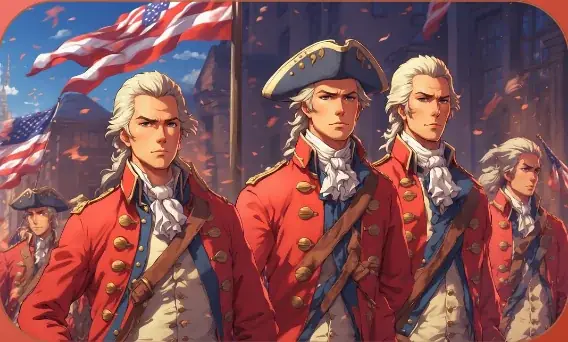
Redcoats: Garnet Character
British soldiers wore red coats mainly because the bright color made it easy to tell friend from foe on a battlefield. Scarlet tunics were already in use by 1658, and by the American Revolution the brick-red wool coat, with cuffs and collars in a color that changed by regiment, was the standard dress of the British infantryman.
- Cost
- 2 crystals
- Type
- Character · Rebel
- Power / Health
- 2 / 2
- Color
- Garnet (Rebels, Pirates & War)
- Rarity
- Common
- Set
- Liberty & Lightning (Set 1)
- Keywords
- Guard
When destroyed: deal 1 damage to an enemy character.
British soldiers made into highly visible targets while simultaneously intimidating the enemy with distinctive fashion choices.
The real history
The red coat has a long history. The National Park Service notes that British soldiers in scarlet tunics first fought on foreign soil at the Battle of the Dunes, near Dunkirk, on June 14, 1658, when a combined British and French force defeated Spanish troops. The same source says the bright color let soldiers easily tell friends from enemies.
By 1775 the coat was the main outer garment of the British infantryman, worn all year. It was made of heavy, tightly woven wool broadcloth, lined with a lighter wool called bay, and held more than forty buttons stamped with the regiment's number. The coat itself was a brick red, but the cuffs, lapels and collar could be blue, green, yellow, white or black depending on the regiment. Modern reenactment standards for the period describe enlisted men's coats as madder red, sergeants' as a mock scarlet and officers' as true scarlet. Artillery crews wore dark blue instead.
Not every soldier fighting for the king wore red. Some Loyalist units, such as the Queen's Rangers, were known for green coats.
Colonists had other names for the soldiers too. They mocked them as "bloody backs," a jab at the floggings officers used to punish them, not at the color of their uniforms.
Red coats stayed in use as dress uniform through the 19th century. They were phased out during World War I, in part because the dye was comparatively expensive.
Sources
- Origin of the Redcoats (Battle of the Dunes), National Park Service
- The British Soldier of 1775, Minute Man National Historical Park, National Park Service
- Authenticity Standards for British Regular Army Impressions, Minute Man National Historical Park, National Park Service
- British Discipline During the Revolutionary War, American Battlefield Trust
How the card plays
Redcoats costs 2 crystals and is a 2/2 Garnet Rebel. It has Guard, and when it is destroyed it deals 1 damage to an enemy character of your choice.
For two crystals you get a blocker that always leaves a parting shot. Put it in front of your better characters so that attackers must go through it, and aim its last point of damage at a 1-health enemy or at a character that is already hurt. Andrew Jackson deals 1 damage to each enemy character when played, so the two together can finish off small targets. Lexington & Concord gives your Soldiers and Rebels +1/+0, and George Washington, Freeworld Founder gives your other characters +1/+1, which turns a cheap wall into a 3/3 that is hard to chew through.
- Playable in decks led by Edward Teach "Blackbeard", and by any Traveler Leader whose colors include Garnet.
- In the Blackbeard starter deck (2 copies). Deck code:
LC2-Aj4BPwFAAUEBQgFDAUQCRQFGAkcBSAFJAkoBSwFMAU0BTgFPAlACUQFSAVMCVAFVAVYBVwFYAVkBWgFbAVwBXQJeAW9C - A deck holds up to 3 copies of this card.
Questions about Redcoats
Why did colonists call British soldiers bloody backs?
The insult referred to the floggings that British officers often used as punishment, which left soldiers' backs bloody. It was not about the red color of their coats.
Related cards
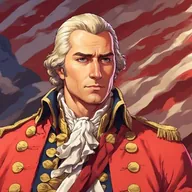 Benedict Arnold, Turncoat7 crystals · Character · Legendary
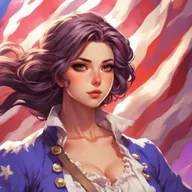 Betsy Ross, American Dream6 crystals · Character · Ultra-Rare
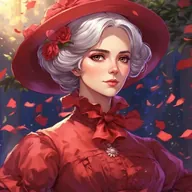 Susan B. Anthony2 crystals · Character · Uncommon
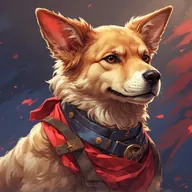 Rebel, Two Sided Hound1 crystal · Character · Common
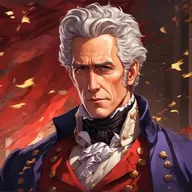 Andrew Jackson3 crystals · Character · Uncommon
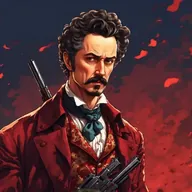 John Wilkes Booth5 crystals · Character · Common
Free in your browser. No download.
Play Redcoats free