 Lost Chapters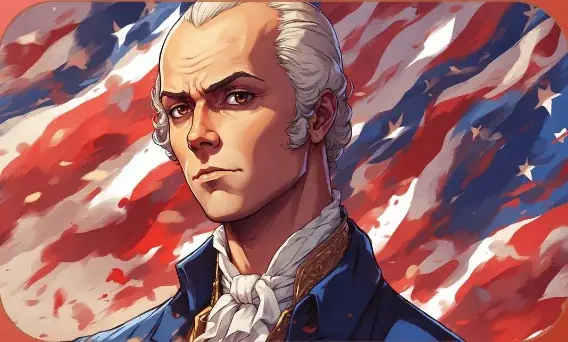
Aaron Burr: Garnet Character
Aaron Burr was a Revolutionary War officer, New York lawyer and U.S. senator who served as the third vice president of the United States under Thomas Jefferson. He is best known for killing Alexander Hamilton in a duel in 1804 and for his 1807 treason trial, which ended in acquittal.
- Cost
- 5 crystals
- Type
- Character · Rebel
- Power / Health
- 4 / 4
- Color
- Garnet (Rebels, Pirates & War)
- Rarity
- Uncommon
- Set
- Liberty & Lightning (Set 1)
On play: duel an enemy character (each deals damage equal to its power to the other).
When destroyed: deal 2 damage to an enemy character.
Political schemer whose impatience for power led to a famous duel, treason charges, and eventually a hit Broadway musical.
The real history
Aaron Burr was born in Newark, New Jersey, on February 6, 1756, into a family of famous ministers. His father was president of the College of New Jersey, now Princeton, and his grandfather was the theologian Jonathan Edwards. Orphaned as a small child, he entered Princeton at 13.
In 1775 Burr left his law studies to join the army. He took part in the invasion of Canada, served briefly on Washington's staff and rose to lieutenant colonel before poor health led him to resign in 1779. He then built a law practice in New York and served as the state's attorney general and as a U.S. senator.
In 1800 Burr ran as Jefferson's running mate. At the time, electors cast two votes without marking which was for president, and Jefferson and Burr tied. The House of Representatives had to decide. Burr did not step aside, and it took 36 ballots before Jefferson won. Burr became vice president, but Jefferson never trusted him again.
In 1804 Burr ran for governor of New York and lost, with Alexander Hamilton leading the attacks on his character. Burr challenged him to a duel. On July 11, 1804, at Weehawken, New Jersey, Burr shot Hamilton, who died the next day. Burr was charged with murder in New York and New Jersey but never tried.
Out of office, Burr joined a murky scheme in the West. Accusers said he planned to seize western and Spanish lands for a nation of his own; the details remain unclear. In 1807 he was tried for treason in Richmond, Virginia, before Chief Justice John Marshall. The prosecution could not prove an overt act of war, and the jury acquitted him. Burr spent four years in Europe, came home to practice law again and died in 1836.
Sources
- Aaron Burr (1801 to 1805), Miller Center, University of Virginia
- Aaron Burr, American Battlefield Trust
- U.S. v. Aaron Burr: The Treason Trial, Federal Judicial Center
In the game's story
In the game's invented story, Burr and Hamilton are both pulled into Marginalia from 1801, before the duel, and both know how it ends. Burr takes a room at the far end of the realm in Errata Harbor, where he wins cases for Bridgecrew sailors against the harbor council. By royal order the two men are never to be in the same room, and Captain Isguard enforces it personally.
How the card plays
Aaron Burr costs 5 crystals and is a 4/4 Garnet Rebel for Blackbeard decks. When he enters play, he duels an enemy character: each deals damage equal to its power to the other. When Burr is destroyed, he deals 2 damage to an enemy character.
That makes him removal with a backup plan. Aim the duel at a character with 4 health or less to destroy it. Against something bigger, the duel still leaves damage on it for the turn, and if Burr falls, his parting 2 damage can finish it or hit another target. Lexington & Concord gives your Rebels +1/+0, so Burr duels at 5 power, and Betsy Ross, American Dream adds another +1/+0. Redcoats shares his parting shot, dealing 1 damage when it is destroyed.
- Playable in decks led by Edward Teach "Blackbeard", and by any Traveler Leader whose colors include Garnet.
- In the Blackbeard starter deck (1 copy). Deck code:
LC2-Aj4BPwFAAUEBQgFDAUQCRQFGAkcBSAFJAkoBSwFMAU0BTgFPAlACUQFSAVMCVAFVAVYBVwFYAVkBWgFbAVwBXQJeAW9C - A deck holds up to 3 copies of this card.
Questions about Burr
Why did Aaron Burr and Alexander Hamilton duel?
Hamilton had opposed Burr for years and led the attacks on his character during Burr's 1804 run for governor of New York. Burr demanded an explanation, then challenged Hamilton, who was mortally wounded at Weehawken on July 11, 1804.
Was Aaron Burr guilty of treason?
He was acquitted. At his 1807 trial in Richmond, Chief Justice John Marshall held that treason required proof of an overt act of war, which the Constitution says must be backed by two witnesses, and the prosecution could not provide it.
Related cards
 Benedict Arnold, Turncoat7 crystals · Character · Legendary
 Betsy Ross, American Dream6 crystals · Character · Ultra-Rare
 Susan B. Anthony2 crystals · Character · Uncommon
 Rebel, Two Sided Hound1 crystal · Character · Common
 Andrew Jackson3 crystals · Character · Uncommon
 Redcoats2 crystals · Character · Common
Free in your browser. No download.
Play Burr free