 Lost Chapters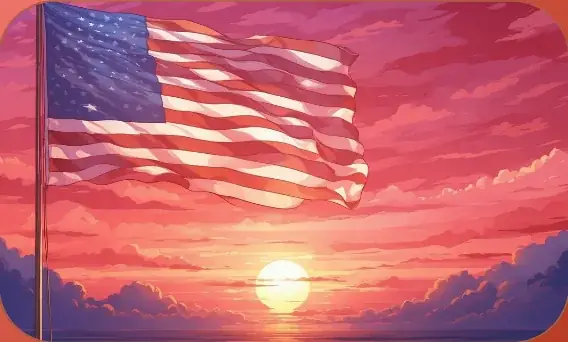
The Flag: Garnet Item
The Continental Congress adopted the first official American flag on June 14, 1777, with thirteen red and white stripes and thirteen white stars on a blue field. The design changed as the country grew, and the 50-star design was set in 1959, after Alaska and Hawaii became states, and first raised officially in 1960.
- Cost
- 5 crystals
- Type
- Item · Treasure
- Color
- Garnet (Rebels, Pirates & War)
- Rarity
- Common
- Set
- Liberty & Lightning (Set 1)
Your characters get +1/+1.
Patriotic symbol that transforms colored cloth into sacred national identity worth pledging allegiance to daily.
The real history
On June 14, 1777, the Second Continental Congress passed a resolution that the flag of the United States should have thirteen stripes, alternate red and white, and that the union should be thirteen white stars in a blue field, "representing a new constellation." It said how many stars to use but not how to arrange them, so early flags looked different from one another.
In the 1790s Vermont and Kentucky joined the Union, and Congress changed the flag to fifteen stars and fifteen stripes. That is the flag that flew at Fort McHenry in Baltimore. In 1813 the flag maker Mary Pickersgill made a huge garrison flag, 30 by 42 feet, for the fort. Francis Scott Key saw it still flying on September 14, 1814, after a British bombardment, and wrote the poem that became the national anthem.
After the War of 1812 more states had joined, and Congress wanted a design that could last. It passed the Flag Act of 1818, which President Monroe signed on April 4. The law returned the stripes to thirteen, for the original colonies, and added one star for each new state on the next Fourth of July. At that time the flag had twenty stars. Captain Samuel C. Reid, a naval hero of the War of 1812, is credited with the idea.
President Woodrow Wilson asked Americans to observe June 14 as Flag Day in 1916, and Congress made it official in 1949. Alaska became the 49th state in January 1959, and an executive order set the 49-star design. A second order that August set the 50-star design after Hawaii joined. The public sent in more than 3,000 designs, and the 50-star flag was first raised officially at Fort McHenry on July 4, 1960.
Sources
- Celebrating Flag Day, National Archives, The Unwritten Record
- Hoist the Colors!, History, Art and Archives, U.S. House of Representatives
- The Great Garrison Flag, Fort McHenry National Monument, National Park Service
- Design of the 49- and 50-Star Flags, Dwight D. Eisenhower Presidential Library
How the card plays
The Flag costs 5 crystals and is a Garnet Item (Treasure). Its card text is Your characters get +1/+1, so every character you control grows by 1 power and 1 health while it is in play.
It is best when you already have a wide board, because each extra character gets the bonus. Tokens benefit as much as big characters, so it turns a pile of 1/1s into 2/2s. Betsy Ross, American Dream Betsy Ross, American Dream gives your other characters +1/+0, and together they make an army hit much harder. George Washington, Freeworld Founder George Washington, Freeworld Founder gives your other characters +1/+1, and The Statue of Liberty The Statue of Liberty does the same, so several of these in play grow your whole team quickly.
- Playable in decks led by Edward Teach "Blackbeard", and by any Traveler Leader whose colors include Garnet.
- In the Blackbeard starter deck (1 copy). Deck code:
LC2-Aj4BPwFAAUEBQgFDAUQCRQFGAkcBSAFJAkoBSwFMAU0BTgFPAlACUQFSAVMCVAFVAVYBVwFYAVkBWgFbAVwBXQJeAW9C - A deck holds up to 3 copies of this card.
Questions about The Flag
How many stars were on the first American flag?
Thirteen, one for each of the original states. The Flag Resolution of June 14, 1777 called for thirteen white stars in a blue field and thirteen red and white stripes.
Related cards


Free in your browser. No download.
Play The Flag free